What you’ll learn:
- A 1-ounce handful of nuts runs 150–190 calories depending on the type, with walnuts at the high end and cashews at the low end.
- “A handful” and “1 ounce” often aren’t the same amount—a loose grab from the bag and the size of your hand can easily double the calorie count.
- Because nuts are so calorie-dense, they’re one of the few snacks worth measuring instead of eyeballing.
Grabbing a handful of nuts instead of chips is often considered a smart snack swap. Why? Nuts are rich in heart-healthy fats and also provide protein, fiber, and a variety of vitamins and minerals. But because they’re often labeled a “healthy snack,” it’s easy to pour a little more than you realize. And that little extra can add up.
While nuts are undeniably nutritious, they’re also calorie-dense. Most of their calories come from fat rather than protein or fiber. While the unsaturated fats in nuts are linked to heart and metabolic health, they still count toward your daily calorie intake.
But the calorie density of nuts doesn’t automatically prevent you from losing weight. Research suggests nuts can fit well into a weight-loss plan and may even support weight loss for some people by helping them stay satisfied. Exactly how they fit depends on your eating pattern. Some people find that nuts help curb hunger between meals, while others prefer larger portions of lower-calorie foods. Like any food, eating more calories than your body needs over time can make weight loss more difficult.
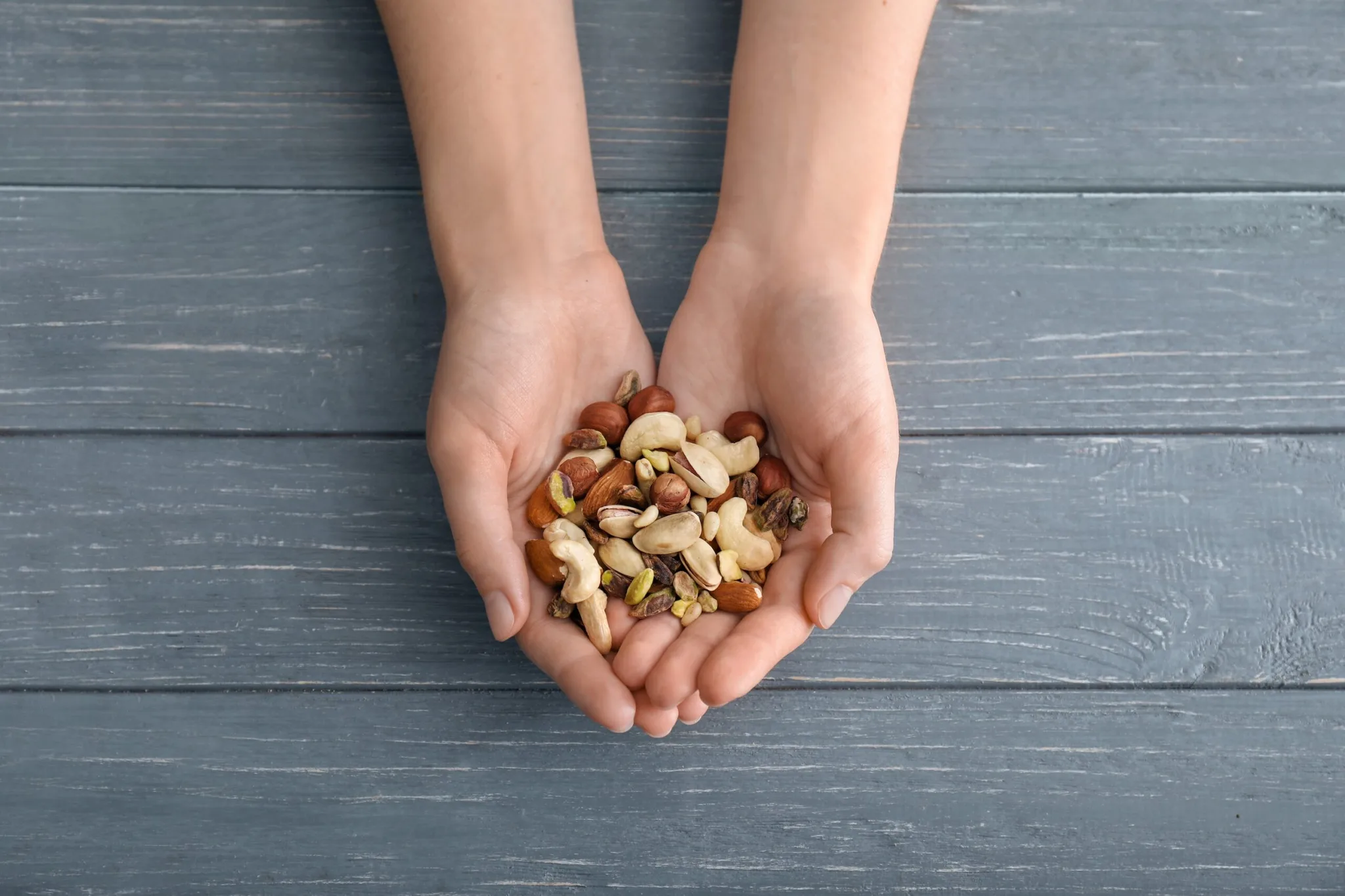
So, how many calories are in a handful of nuts? The honest answer is: it depends. A “handful” isn’t a standardized serving, and the number of calories can vary based on both the type of nut and the size of your handful.
Let’s look at what counts as a serving, how calorie counts vary by nut, and why understanding portion size can help you enjoy nuts while working toward your weight-loss goals.

The Easy Way
to lose weight and get healthy.
See if you qualify
Quick answer: How many calories are in a handful of nuts?
- A standard serving of nuts—about 1 ounce (28 grams), or roughly ¼ cup—contains 150 to 190 calories, depending on the type. But because people don’t naturally tend to measure out nuts before snacking, a real-life “handful” is often closer to 1½ or even 2 ounces, which can push the calorie count to 300 calories or more.
What counts as “a handful” of nuts?
This is where things get tricky. The standard serving size for nuts is 1 ounce (28 grams), but most people don’t think in ounces when they’re grabbing a snack. And because different nuts are different sizes, 1 ounce can look surprisingly different depending on what’s in your hand. Here’s a look at how many nuts make up a serving size:
| Nut | About 1 ounce |
|---|---|
| Pistachios (kernels) | 49 |
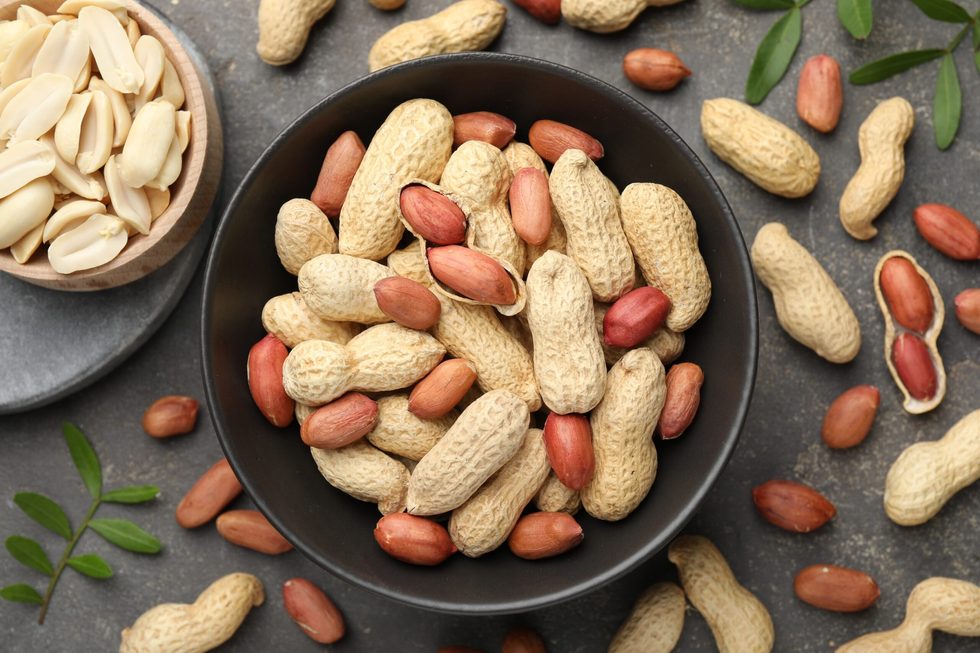
| Peanuts | 28 |
| Almonds | 23 |
| Hazelnuts | 21 |
| Cashews | 18 |
| Pecan halves | 19 halves |
| Walnut halves | 14 halves |
| Macadamia nuts | 10–12 |
| Brazil nuts | 6–8 |
The challenge is that a “handful” isn’t a standard measurement. Someone grabbing a handful of pistachios with shells will end up with a very different number of nuts than someone grabbing a handful of macadamias—and even the same person can pour very different amounts from one day to the next.
Plus, depending on the size of your hand and how generously you scoop, a handful can easily be closer to 1½ or even 2 ounces. That means a snack you think is around 160 calories could actually be 240 to 370 calories, depending on both the portion size and the type of nut.
Why nuts are worth measuring, at least at first
Most healthy foods don’t require perfect portioning. If you grab an extra handful of spinach, broccoli, or carrots, you’re only adding a small number of calories.
Nuts are different. Because they’re so calorie-dense, a portion that’s just a little larger than you intended can add 100 calories or more. That’s why they’re one of the few foods where measuring can make a meaningful difference if you’re trying to lose weight or maintain it.
You don’t have to weigh every handful forever. But using a kitchen scale or measuring cup a few times can help you learn what 1 ounce (about ¼ cup) actually looks like. Once you have that visual reference, it’s much easier to estimate portions confidently without feeling like you have to measure every snack.
Calories in a handful of nuts, by type
Nuts are packed with nutrients, but they’re also calorie-dense, which means portion size matters. The chart below shows how calories increase as servings grow from 1 ounce to 2 ounces, along with approximately how many nuts that looks like for each variety.
| Nut | 1 oz | 1.5 oz | 2 oz |
|---|---|---|---|
| Cashews | 157 (18 nuts) | 236 (27 nuts) | 314 (36 nuts) |
| Pistachios | 159 (49 kernels) | 239 (74 kernels) | 318 (98 kernels) |
| Peanuts | 161 (28 peanuts) | 242 (42 peanuts) | 322 (56 peanuts) |
| Almonds | 164 (23 almonds) | 246 (35 almonds) | 328 (46 almonds) |
| Hazelnuts | 178 (21 nuts) | 267 (32 nuts) | 356 (42 nuts) |
| Walnuts | 185 (14 halves) | 278 (21 halves) | 370 (28 halves) |
| Brazil nuts | 187 (6–8 nuts) | 281 (9–12 nuts) | 374 (12–16 nuts) |
| Pecans | 196 (19 halves) | 294 (29 halves) | 392 (38 halves) |
| Macadamia nuts | 204 (10–12 nuts) | 306 (15–18 nuts) | 408 (20–24 nuts) |
Why the numbers vary so much in a handful of nuts
Not all nuts pack the same number of calories into an ounce. Even though they’re all nutritious, their nutrition profiles differ in a few important ways.
- Fat content: Fat is the biggest driver of calories in nuts, and some varieties naturally contain more of it than others. Walnuts and macadamia nuts are higher in fat than pistachios or cashews, which is one reason they contain more calories per ounce.
- Size and shape: An ounce is measured by weight, not by the number of nuts. Smaller nuts, like pistachios, give you many more pieces per serving than larger nuts, like Brazil nuts or macadamias. That can make a serving feel more satisfying, even when the calorie count is similar.
- Preparation: Raw and dry-roasted nuts have very similar calorie counts. But nuts roasted in oil or coated with sugar, chocolate, honey, or seasonings can add extra calories beyond what the nut provides on its own.
If you’re comparing plain nuts, the calorie differences mostly come down to each nut’s natural fat content—not whether it’s raw or roasted. And while the range isn’t huge (about 150 to 190 calories per ounce), it becomes much more noticeable as portions grow from one ounce to two.
The size of the nuts—and whether they’re shelled—can matter, too. An ounce of pistachios contains about 49 kernels, while an ounce of macadamia nuts is only 10 to 12 nuts. That means two handfuls of different nuts can look very different, even if they weigh the same—or they can look similar while containing different calorie totals.

See if your insurance
covers GLP-1s.
The form only takes 2 minutes to answer. We’ll handle the rest.
GET STARTEDIf you’re eating in-shell pistachios, there’s another factor at play. Having to crack each shell naturally slows down eating, and the growing pile of empty shells can serve as a visual reminder of how much you’ve already eaten. Some research suggests this may help people eat less without feeling less satisfied.
How many calories are in a handful of mixed nuts?
Mixed nuts are one of the most popular ways to snack on nuts, but they’re also one of the hardest to estimate. A typical 1-ounce (28-gram) serving of mixed nuts contains about 165 to 175 calories, though the exact number depends on what’s in the mix.
That’s because “mixed nuts” isn’t a standardized food. Every brand uses a different combination of nuts. Mixes that contain more cashews, pistachios, peanuts, or almonds generally fall toward the lower end of the calorie range, while those with more walnuts, pecans, or macadamia nuts fall toward the higher end.
The easiest way to know what you’re eating is to check the label on your specific brand. If you’re just looking for a ballpark estimate, about 170 calories per ounce is a reasonable place to start. Just remember that if your “handful” is closer to 1½ or 2 ounces, that snack can quickly climb to 255 to 340 calories.
Are nuts a good source of protein?
Yes—but they’re actually an even better source of healthy fats. While nuts contain a respectable amount of protein, most provide about two to five times more fat than protein by weight, and roughly 70% to 90% of their calories come from fat.
That isn’t a drawback. Most of the fat in nuts is unsaturated fat, the type linked to better heart and metabolic health. It’s also one of the reasons nuts are so satisfying: the combination of protein, healthy fats, and fiber helps slow digestion and keep you feeling full longer than many processed snacks.
Here’s how the most common nuts compare in a 1-ounce (28-gram) serving of raw, unsalted nuts.
| Nut (1 oz, raw) | Protein | Fat |
|---|---|---|
| Peanuts (about 28) | 7 g | 14 g |
| Almonds (about 23) | 6 g | 14 g |
| Pistachios (about 49 kernels) | 6 g | 13 g |
| Cashews (about 18) | 5 g | 12 g |
| Walnut halves (about 14) | 4 g | 19 g |
| Hazelnuts (about 21) | 4 g | 17 g |
| Brazil nuts (about 6–8) | 4 g | 19 g |
| Pecan halves (about 19) | 3 g | 20 g |
| Macadamia nuts (about 10–12) | 2 g | 22 g |
While every nut offers a mix of protein and healthy fats, a few differences are worth noting, especially if you’re choosing nuts with a specific nutrition goal in mind.
- Peanuts provide the most protein per ounce. At 7 grams, they top the list despite sitting in the middle of the pack for fat. That’s because peanuts are technically a legume, not a tree nut, giving them a different protein-to-fat balance.
- Almonds and pistachios aren’t far behind. With 6 grams of protein per ounce, they’re among the best choices if you’re looking for a snack that delivers a bit more protein.
- Macadamias and pecans are highest in fat. They’re among the richest sources of heart-healthy fats, but they contain the least protein, making them a great reminder that not all nuts have the same nutrition profile.
- Walnuts earn their place for a different reason. While they provide a moderate amount of protein, they’re one of the richest sources of plant-based omega-3 fatty acids, a healthy fat linked to heart and brain health.
The bottom line? Nuts are a good source of protein—but they’re an even better source of healthy fats. If you’re looking to maximize protein, reach for peanuts, almonds, or pistachios. If your goal is to enjoy the broader health benefits of nuts, any variety can be part of a healthy eating pattern.
Are nuts good for weight loss?
They can be. Despite being calorie-dense, research suggests that regularly eating nuts isn’t associated with weight gain and may even support weight loss for some people. That’s likely because nuts are rich in healthy fats, protein, and fiber—a combination that can help you feel satisfied and make it easier to stick with your eating plan.
That said, nuts aren’t the perfect weight-loss food for everyone. If you’re someone who feels most satisfied by larger portions of lower-calorie foods, you may find that a handful of nuts doesn’t keep you as full as a big bowl of vegetables, fruit, or soup. On the other hand, if you do well with higher-protein or lower-carb eating patterns, nuts may be one of the snacks that helps you stay satisfied between meals.
The key is finding what works for you. Successful weight loss isn’t about choosing the “best” food—it’s about building an eating pattern you can stick with. For some people, that means measuring out a serving of nuts and enjoying them regularly. For others, it may mean pairing a smaller portion of nuts with a piece of fruit or vegetables to add more volume.
If you notice yourself absentmindedly reaching back into the bag, that’s not a sign you should stop eating nuts altogether. It’s simply a cue that portioning out a serving first may help you enjoy their benefits while staying aligned with your goals.
The bottom line: A handful of nuts can vary in calories
Nuts are one of the few healthy snacks where grabbing a handful might not work for everyone. A handful of walnuts and a handful of cashews may look similar, but they don’t contain the same number of calories. And if you eat straight from the bag, it’s easy for one handful to turn into two or three without realizing it.
That doesn’t mean you need to avoid nuts if you’re trying to lose weight. In fact, for many people, their combination of healthy fats, protein, and fiber makes them a satisfying snack that can fit well into a balanced eating pattern. The key is recognizing that nuts are calorie-dense and treating portion size as part of the equation, not an afterthought.
If nuts are a regular part of your routine, the fix is simple—and a little unglamorous. Portion them out before you start eating. A kitchen scale is the most accurate option, but a measuring cup or small container works well, too. Once you’ve seen what a 1-ounce serving looks like a few times, you’ll be much better at estimating it without measuring every snack.
Ultimately, there’s no “best” nut for weight loss. The best choice is the one you enjoy, that helps keep you satisfied, and that fits comfortably within your overall eating pattern. A measured handful of almost any nut can be part of a healthy, sustainable approach to weight loss. Download the Noom app today on iOS & Android for more personalized guidance, daily tips, and answers to questions like these.
Editorial standards
At Noom, we’re committed to providing health information that’s grounded in reliable science and expert review. Our content is created with the support of qualified professionals and based on well-established research from trusted medical and scientific organizations. Learn more about the experts behind our content on our Health Expert Team page.